Base Shear Coefficient | Allowable story drift | Allowable story displacement (NBC – 2025)
| Ta | – |
| Tc | – |
| Td | – |
| α | – |
| Response reduction factor (Rμ) | – |
| Overstrength factor ULS (Ωu) | – |
| Overstrength factor SLS (Ωs) | – |
| —————— | |
| Fundamental Translation period (sec) (T) | 0.000 |
| Building Height exponent (k) | 0.000 |
| Spectral shape factor Ch(T) | 0.000 |
| Elastic site spectra C(T) | 0.00000 |
| Elastic site spectra for serviceability limit state Cs(T) | 0.00000 |
| —————— | |
| Horizontal base shear coefficient (SLS) Cd(T) | 0.00000 |
| Horizontal base shear coefficient (ULS) Cd(T) | 0.00000 |
| —————— | |
| Allowable story drift ratio (ULS) | 0.00000 |
| Allowable story drift ratio (SLS) | 0.00600 |
| Allowable story displacement (ULS), mm | 0.0000 |
| Allowable story displacement (SLS), mm | 0.0000 |
What is Base and Base Shear?
BASE: The level at which the inertia forces developed in the building structure are
accumulated before being transferred to the ground through the foundation. It is
considered to be at the bottommost level of basement, or at the top of pile cap, or
at the top of raft, or at the top of the footing.
BASE SHEAR: Total design lateral force or shear force due to earthquake at the
base of a structure.
HORIZONTAL BASE SHEAR COEFFICIENT

HORIZONTAL SEISMIC BASE SHEAR
The horizontal seismic base shear, V, acting at the base of the structure, in
the direction being considered, shall be calculated as:
V = Cd (T1) W
Where,
Cd (T1) = Horizontal base shear coefficient as per 6.1
W = Seismic Weight of the structure as per 5.2 (NBC)
VERTICAL DISTRIBUTION OF SEISMIC FORCES

Where,

n= total number of floors/levels
V= horizontal seismic base shear calculated as per 6.2
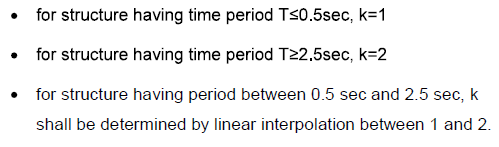
k= an exponent related to the structural period as follows:
Base Shear Cofficient Depends on these Factors
- Z
Effect. Higher Z, higher base shear coefficient. - I
Effect. Higher I, higher base shear coefficient. - Ch(T)
Effect. Higher Ch(T), higher base shear coefficient. - Ru
Effect. Higher Ru, lower base shear coefficient. - Ωs
Effect. Higher Ωs, lower base shear coefficient for SLS. - Qu
Effect. Higher Qu, lower base shear coefficient for ULS. - T
Effect. Higher T usually reduces Ch(T). Base shear coefficient usually reduces. - kt
Effect. Higher kt increases T. Base shear coefficient usually reduces. - H
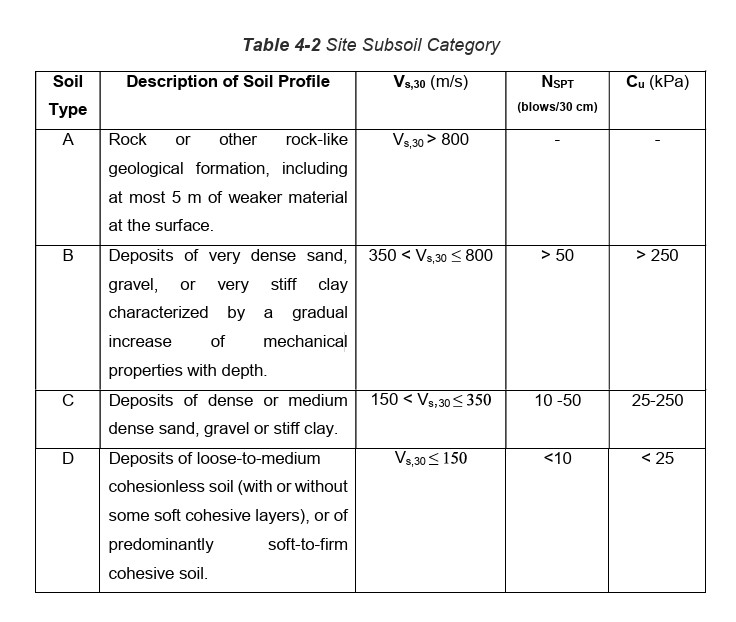
Effect. Higher H increases T. Base shear coefficient usually reduces. - Soil type
Effect. Softer soil increases Ch(T). Base shear coefficient increases.
What is Allowable story drift ratio (ULS)?
The maximum permitted relative lateral displacement between two consecutive storeys, divided by the storey height, under earthquake load at the Ultimate Limit State. It ensures prevention of structural instability and collapse as per NBC.
What is Allowable story drift ratio (SLS)?
The maximum permitted relative lateral displacement between two consecutive storeys, divided by the storey height, under earthquake load at the Serviceability Limit State. It ensures acceptable damage control and occupant comfort as per NBC.
What is Allowable story displacement (ULS)?
The maximum permitted absolute lateral displacement of a storey under earthquake load at the Ultimate Limit State. It is derived from the allowable story drift ratio and storey height, ensuring overall structural safety as per NBC.
What is Allowable story displacement (SLS)?
The maximum permitted absolute lateral displacement of a storey under earthquake load at the Serviceability Limit State. It limits non structural damage and maintains usability of the building as specified in NBC.
Use of the calculator
- Preliminary seismic design
Used to quickly estimate base shear coefficient, story drift, and displacement during early stage structural design as per NBC. Helps you check seismic demand before detailed ETABS or SAFE modeling. - NBC code compliance check
Used to verify whether calculated drift and displacement limits satisfy NBC requirements for ULS and SLS. Helps you avoid code violations at approval or review stage. - Design comparison and optimization
Used to compare different soil types, structural systems, importance factors I, and zone factor Z. Helps you understand how design choices affect seismic forces and drift. - Educational and training purpose
Used to understand the relationship between Z, I, Ch(T), Ru, Ω, height, and period. Useful for concept clarity and teaching seismic behavior.
Who can use this calculator?
- It is Used by structural engineers for quick seismic checks, validation of ETABS results, and concept level decision making.
- It is Used by Civil engineers and designers Used to understand seismic demand and code limits during building planning and coordination.
- It is Used by Engineering students to learn NBC based seismic parameters, drift limits, and base shear concepts in a practical way.
- It is Used by Municipal engineers and reviewers to perform rapid verification of submitted designs against NBC seismic provisions.
Read Also,
Structural analysis notes | PDF Free Download
