A compression member i.e. column is an important element of every reinforced concrete structure. These are used to transmit the load of superstructure to the foundation safely.
A column is a vertical compression member which is mainly subjected to axial loads and the effective length of which exceeds three times its lateral dimension.
In structural engineering, columns are vertical members designed to support compressive loads. However, not all columns behave the same way under pressure. Based on their behavior under loading or slenderness ratio, columns are broadly classified into two types. They are;
- short columns
- long columns.
Understanding their differences is essential for safe and efficient structural design.

Types of column

- Short Column
- Long Column
What is short columns?
Columns with a small height compared to its cross-sectional dimensions is known as short columns. A short column is the one whose slenderness ratio (effective length/least lateral dimension) is less than or equal to 12.
Since, it is thick relative to its height, it is incredibly stable. They are more efficient at carrying massive loads because they utilize the full compressive of the material(concrete or steel) that’s why they are preferred in heavy construction.

What is long columns?
Columns with a large height compared to its cross-sectional dimensions is known as long column. A long column, also known as a slender column and is the one whose slenderness ratio (effective length/least lateral dimension) is greater than 12. These columns are thin compared to their length.

Short column and Long column- Difference
a) Slenderness ratio (λ):- The slenderness ratio is the ratio of the effective length of the column to the least lateral dimension of the column.
Classification of column depends on the slenderness ration. This is the ratio of the effective length (Le) to its least radius of gyration (r).
Short column : usually less than or equal to 12.
Long column : usually greater than 12.
b) Mode of failure
Short column : Short columns fail by crushing. The material itself reaches its ultimate compressive strength and yields or shatters.
Long column : Long columns fail by buckling. This is a sudden lateral deflection (bending) that occurs even if the material hasn’t reached its crushing point. the buckling behavior of long column is explained by Euler’s buckling formula, which gives the critical stress at failure;
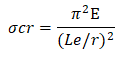
Where,
σcr = critical stress
E = the Modulus of Elasticity.
Le = the effective length (based on end supports).
r = the least radius of gyration.
c. Load carrying capacity;
Short column: They can typically carry higher loads because they utilize the full strength of the material (concrete or steel).usually calculated by multiplying the cross sectional area and allowable stress of the material.
Long column: Their capacity is significantly lower than short columns because they fail prematurely due to instability. Calculated using Euler’s buckling formula.
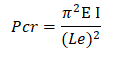
Where, E is the modulus of elasticity.
I is the moment of inertia.
d. Design consideration
- Short column: The design is primarily concerned with the cross-sectional area and the compressive strength of the material.
- Long column: The design is governed by the Euler Buckling Formula, which focuses on the “stiffness” (Moment of Inertia) and the “Effective Length” rather than just material strength.
e. Stress distribution
- Short column: it distributes uniform stress over cross section.
- Long column: it distributes non uniform stress due to bending effects.
f. Lateral deflection
Short column: negligible
Long column: significant (buckling)
g. Behavior
Short column: it behaves mainly axial compression.
Long column: it behaves compression as well as bending.
- Example
- Short column: pedestal, low height buildings, short RCC column
- Long column: tall building column
In Short Long Column ans Short column can be defined as,
1. Short Column
The column is considered as short column when the slenderness ratio of column i.e. ratio of effective length to its least dimension,

Lex = Effective length of column in minor axis
Ley = Effective length of column in minor axis
d = Depth of column in respective axis b = Breadth of column
2. Long column
The column is considered as long column when the slenderness ratio of column is greater than 12.
Lex = Effective length of column in minor axis
Ley = Effective length of column in minor axis
d = Depth of column in respective axis
b = Breadth of column
Difference between short column and long column

| SN. | Short Column | Long Column |
| 1 | A column is said to be short if the ratio of effective length to its least lateral dimension is less than or equal to 12. | A column is said to be long if the ratio of effective length of column to its least lateral dimension is greater than 12. |
| 2 | The ratio of effective length of short column to its least radius of gyration is less than or equal to 40. | The ratio of effective length of a long column to its radius of gyration is greater than 40. |
| 3 | Buckling tendency is very low. | Long and slender columns buckle easily. |
| 4 | The load carrying capacity is high as compared to long column of same cross-sectional area. | The load carrying capacity of a long column is less as compared to short column of same cross- sectional area. |
| 5 | The failure of short column is by crushing. | The column generally fails in buckling. |
| 6 | Lateral deflection is negligible. | Lateral deflection is significant. |
| 6 | Example:- Pedestal, short RC column, bridge piers etc. | Example:- Tall building columns, transmission towers, slender steel members etc. |

Conclusion
The main difference between short and long columns lies in their failure mechanism and slenderness ratio. Short columns are governed by material strength, while long columns are governed by stability. Proper classification ensures safe structural design and prevents unexpected failures.
Read Also,
Design of compression members- Design of Column
Effective length of Column- Under Different condition of Fixed-Rotation
10 Cause of crack in concrete structure like Column, Beam, Slab, etc
